Integrating Rose Gold Decorative Star into Your Visual Strategy
In the current landscape of digital design, where saturation is high and attention spans are fleeting, the texture and finish of your graphic assets play a pivotal role in audience retention. We are moving beyond flat, static imagery toward visuals that evoke tactile sensations and emotional responses. The Rose Gold Decorative Star collection represents this shift perfectly. It is not merely a set of shapes; it is a specific mood captured in high-resolution pixels. This asset provides a sophisticated metallic finish that bridges the gap between modern minimalism and luxurious ornamentation.
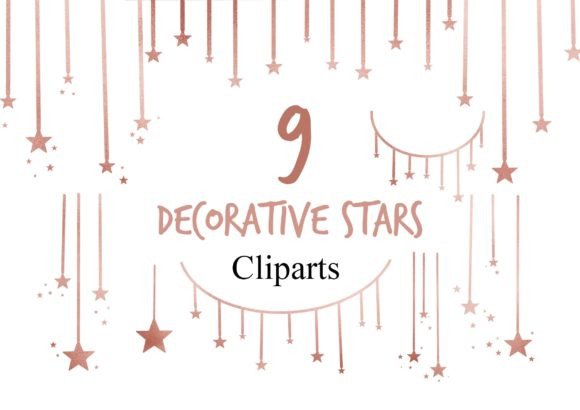
The defining characteristic of this collection is the interplay of light and color within the PNG files. Unlike a standard flat vector, these stars possess a dimensional quality. The "Premium Rosegold" aspect refers to the nuanced gradient—moving from a warm, coppery blush to a soft, champagne highlight. This mimics the way light catches polished metal in the physical world. For designers, this offers a distinct advantage: you get the scalability and ease of a digital file combined with the visual weight of a physical material. The "personality" of these assets is undeniably confident yet approachable; they signal celebration, achievement, and high value without the coldness of silver or the heaviness of gold.
Strategic Applications for Modern Branding
Understanding where to deploy the Rose Gold Decorative Star is essential for maintaining professional integrity. While these elements are versatile, they shine brightest in specific contexts. For entrepreneurs and small business owners, these stars serve as excellent focal points in packaging design. A single star placed on a matte black box or a textured cream card creates an immediate impression of a premium product. It suggests that the contents inside are curated and valuable, which directly influences the customer's perceived value of the purchase.
For content creators and bloggers, the utility extends heavily into social media graphics and web design. In an Instagram grid or a Pinterest board, consistent visual language is key. Using these stars as accent elements—perhaps framing a quote, marking a "swipe up" prompt, or separating text blocks—adds a layer of polish that standard stock graphics cannot match. Because the files come with transparent backgrounds, they integrate seamlessly into complex photo compositions or busy backgrounds, acting as a stabilizing visual anchor.
Furthermore, consider the application in editorial design and publishing. If you are creating a digital planner, a workbook, or a book cover, the Rose Gold Decorative Star can function as a recurring motif. In a planner, a star might denote a "high priority" task or a "reward" section. In a book layout, they can serve as elegant drop caps or section dividers. The key is to use them as punctuation marks within your design hierarchy—elements that guide the eye and break up monotony without overwhelming the core content.
Design Harmony and Font Pairing
A common pitfall in design is treating assets in isolation. The Rose Gold Decorative Star performs best when it is part of a cohesive font pairing strategy. Because the stars have a distinct metallic texture and a warm hue, they can clash with typefaces that are too aggressive or geometrically rigid. Conversely, they pair beautifully with fonts that offer contrast in texture but harmony in tone.
For a high-fashion or luxury aesthetic, pair these stars with a modern, wide-tracked sans serif font. The clean lines of a sans serif will provide a stark, contemporary contrast to the organic shimmer of the rose gold. This combination works exceptionally well for wedding stationery, boutique branding, or tech startups looking to add a "human touch" to their brand identity. Alternatively, if the goal is to evoke tradition, romance, or elegance, combining the stars with a classic serif font creates a timeless look. The sharp serifs ground the design, while the stars provide the visual flair.
Avoid pairing these decorative elements with overly busy handwritten fonts or script fonts that have heavy swashes. The visual noise of a complex script can compete with the metallic detail of the star, resulting in a cluttered appearance. Instead, if you require a script, choose one with open letterforms and a steady baseline. The goal is to let the typography breathe, allowing the Rose Gold Decorative Star to accentuate the message rather than distract from it.
Technical Execution and Asset Management
Practical guidance is necessary when integrating new design assets into your workflow. The collection provides nine distinct variations of the Rose Gold Decorative Star in PNG format at 300dpi. This high resolution is critical for print production. Whether you are printing on fabric for clothes, etching onto keychains, or producing high-end business cards, the 300dpi specification ensures that the edges remain crisp and the metallic gradient does not pixelate or band.
However, designers must remain vigilant regarding color rendering. As noted in the asset specifications, different monitors display color differently. Rose gold is a particularly tricky hue because it relies on the balance between pink and copper tones. A monitor calibrated for cool tones might make the stars look too pink, while a warm-calibrated screen might push them toward orange. If you are working on a commercial project where color accuracy is paramount—such as logo design or physical merchandise—it is advisable to run a test print. This allows you to see how the PNG interacts with your specific paper stock or substrate.
Additionally, while the transparent background allows for easy layering, be mindful of "haloing." This occurs when a PNG is saved with anti-aliasing that doesn't perfectly match the new background. To mitigate this, ensure you are placing the Rose Gold Decorative Star on backgrounds that offer sufficient contrast. A dark navy or charcoal background will make the rose gold pop, while a white background will create a soft, airy aesthetic. On mid-tone backgrounds, you may need to add a subtle drop shadow or outer glow to ensure the star stands out from the composition.
Psychological Impact and Audience Engagement
Why does rose gold work so well in marketing? It comes down to color psychology and material association. In the adult demographic of 20–50, rose gold is often associated with modern sophistication and technological elegance (think of the popularity of rose gold electronics and jewelry). When you use the Rose Gold Decorative Star in your marketing materials, you are subconsciously borrowing that equity.
For a small business owner, using these elements in a promotional email or a sales template can increase engagement. It signals a "special occasion." A standard black-and-white flyer might be ignored, but one accented with metallic stars draws the eye because it mimics the look of a celebration. It suggests that the offer or content inside is exclusive. This is particularly effective for "Happy New Year" campaigns, product launches, or VIP offers.
Ultimately, the Rose Gold Decorative Star